Blowing Up the Whistle
Coyote Vs ACME soars as a comedy because it faithfully builds upon and subverts the expectations of an entirely unexpected genre: the political thriller

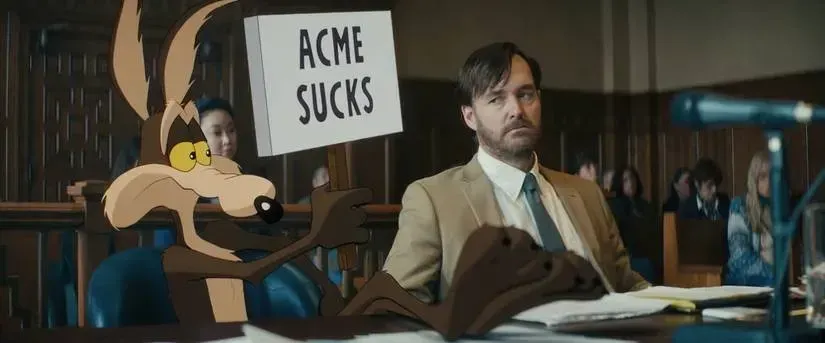
On February 4th, 1996, CBS’s 60 Minutes aired a groundbreaking interview with biochemist and former senior tobacco industry executive Jeffrey Wigand. During his sit-down with journalist Mike Wallace, Wigand confirmed for the public at large what was already an open secret within the world of Big Tobacco: despite testimony to the contrary delivered to Congress, executives within the industry saw themselves as being in the “nicotine delivery business” and were incorporating extremely carcinogenic chemicals into their products in order to boost their narcotic effects. What most of the public did not know at the time was that the airing of the interview itself represented an endpoint tacked onto a years-long campaign of harassment, death threats, character assassination, and strong-arming through the legal system allegedly waged by Wigand’s former employer, Brown & Williamson, against him. The campaign took a dramatic psychological and personal toll on Wigand, but ultimately his interview would have a dramatic effect on the public’s perception of cigarettes, and his testimony in Horton vs. American Tobacco Co. would prove instrumental in a $365 billion national settlement that resulted from the state of Mississippi’s initial lawsuit. Despite losing so much, Jeffrey Wigand and the truth won out.
Today, Jeffrey Wigand’s name persists in popular consciousness – at very least as a name people recognize regardless of their ability to place it in context – for two reasons. As a whistle-blower, Wigand was arguably the earliest and most prolific example of the tradition during the cable news era, his revelations coming at a time when channels still numbered in the tens and when television was still the most pivotal tool for shaping opinion. Despite the allure of television in the 1990s, this alone would not have sufficed to keep Wigand’s name alive for very long, which is where the immortality of film fills in the gaps. When most people finally place Jeffrey Wigand in context, it is thanks to Michael Mann’s brilliant 1999 political thriller The Insider, with Russell Crowe taking on the labor of portraying the fallen biochemist in one of his most highly regarded performances. Nearly thirty years on, The Insider has rightfully taken its place among the all-time great political thrillers, a genre defined at its best not so much by the gravity of the revelations uncovered during the course of a story as it is built around the way the investigations into those secrets lock the audience into the experience. The gratification of a political thriller is in the unraveling.
What a delightful surprise it is to see a Looney Tunes film adopt this frame and run with it.
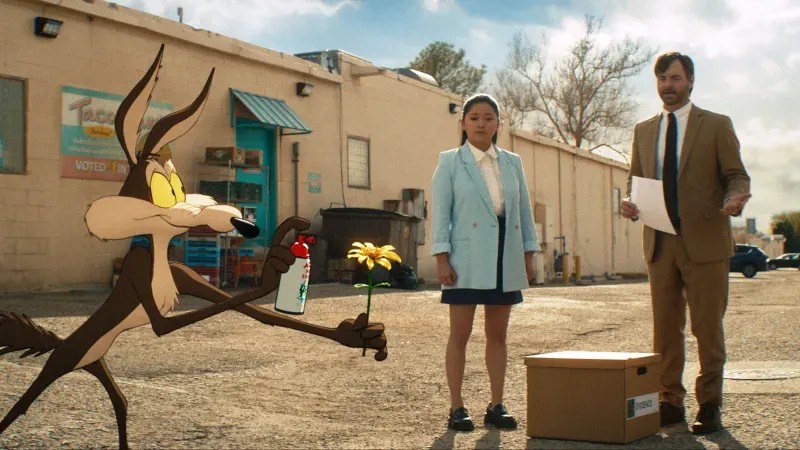
Coyote Vs ACME will read to anyone familiar with the Wile E Coyote and Road Runner cartoons first and foremost as an homage to the characters and a hilarious labor of love, yet to the film’s immense credit it stands firmly on its own foundation beyond being a love letter. It presents audiences with something far more substantive than simple nostalgia through its total investment in its premise and its framework on multiple levels. And though the film faced its own prolonged fight just to arrive on the silver screen, the result of those efforts might just be the most enjoyable theater experience of the summer.
The clearest sign of the deep investment of all involved into the project arrives in how expertly the live action actors thrive within what one could call the “Muppets Principle” – specifically, the more a live action actor acknowledges and internalizes the idea that their Muppet or cartoon co-stars are living, breathing beings with whom they share a scene, the more entertaining the final film or show. In this regard, Will Forte’s turn as the shiftless attorney Kevin Avery is a dynamic performance worthy of Bob Hoskins’ Eddie Valiant or Tim Curry’s Long John Silver. At no point does Forte give away the ghost that he’s spending the bulk of the film acting with air, nor does that air feel empty around him. That might not come as a surprise to anyone familiar with Forte, whose career as a comedic actor has been defined by his ability to totally commit to the most absurd premises – just look back on any of his Tim and Eric Awesome Show Great Job! skits – yet he applies that talent in Coyote vs ACME with exceptional restraint as the film’s straight man and linchpin. Wile E Coyote’s endlessly abysmal luck with ACME products will always provide ammunition for the most delightful visual mayhem, but that outward haplessness reflected equally through the aimlessness of Kevin Avery as the witness to every half-baked scheme adds a welcome dimension to each character. The pair are both hopelessly in over their heads and made for one another.
Forte is by no means the only actor who aces the Muppets Principle over the course of the film. Lana Condor and John Cena each bring their own perspective to that challenge within their roles and arrive at unique answers through their performances. Condor’s pollyannish Paige Avery not only provides the right counterbalance to Kevin Avery’s lack of ambition but also functionally affords the film its conscience. She internalizes the premise of justice for Wile E Coyote and other cartoons wronged by ACME and utilizes that energy to ground that struggle in the narrative as something real. There’s an earnest quality to Condor’s work that emboldens the film’s more heartwarming moments as a result.
As a contrast, John Cena arrives at a different but equally welcome conclusion in his turn as Buddy Crane, the slimy Chief Legal Counsel of the ACME Corporation. Cena finds just the right pitch for a villain in a Looney Tunes film in being outwardly dastardly and unscrupulous without being truly detestable. Moreover, Cena becomes a welcome presence in his scenes because he allows himself to inhabit a cartoon character in his own right. Whether he’s withering in the presence of ACME CEO Foghorn Leghorn, belittling Kevin Avery for taking on a case bigger than his abilities, or demanding to know why his cohort can’t manage to catch one Road Runner, Cena accentuates his emotions just enough to complement the hijinks, tapping into the wisdom of pro wrestling to sell at very nuanced level.
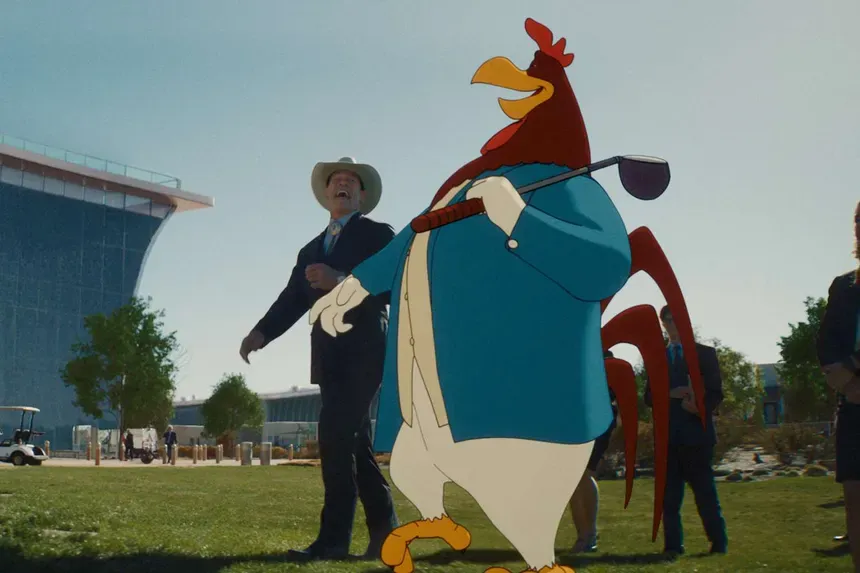
And then there are the Looney Tunes themselves, the purveyors of the film’s many wonderful gags as well as its central conflict. It is through their presence that Coyote Vs ACME reveals itself as being invested in a particularly tricky brand of comedy. Rather than constructing a lampoon, spoof, or satire, the filmmakers chose to frame the Coyote Vs ACME as a pastiche of the political thriller, presenting the ACME Corporation’s threats to whistle-blowers and litigants through the lens of how we have come to expect ominous monopolistic edifices to operate in popular consciousness – especially when they have something to hide.
It’s an exceptionally adept narrative choice which indicates a refined understanding of the comedy at play when dealing specifically with Wile E Coyote and Road Runner. The iconic cartoons are a masterclass in slapstick, visual gags, and comedic timing, all premised upon the surprise and shock of just how badly the contraptions ACME sells Coyote backfire. In a comedy feature film, the necessary inclusion of those gags is going to do a lot of the heavy lifting in earning the big laughs from the audience, and that is certainly the case here. If someone’s primary draw to this film is seeing Wile E Coyote getting crushed by a giant flyswatter or catching up with his eternal enemy: gravity, it has a feast of impressively written and executed slapstick prepared. But with rare exceptions, 101 minutes of visual gags need to be held together by a strong spine, and that is Coyote Vs ACME’s true super genius: scripting the film as a political thriller that takes itself seriously underneath the humor.
In some respects, Coyote Vs ACME reflects a truth pioneered by the legendary 1980 comedy Airplane and how it directly spoofed 1957’s Zero Hour, namely that the key to drawing out the humor in a dramatization is to treat the narrative and the stakes as deadly serious. It is in this aspect where the affection of all involved with the film and the story it has to tell becomes crystal clear. The film’s dedication to the adornments and staples of the genre serves it well throughout. Wile E Coyote’s case and the web of malfeasance at scale it reveals within the ACME Corporation is handled with story beats that would not feel out of place within The Insider or fellow classics All the President’s Men and Spotlight. They are built from the same narrative connective tissue, and it is the steadfast commitment to adopting this framework that allows the absurdity of the comedy within the film to soar. Coyote Vs ACME threads the needle both as slapstick comedy and also as a surreptitious initiation into a much more sober genre for moviegoers who wouldn’t typically find interest in films reliant on slow burning reveals
In particular, ACME’s attempts to silence the Coyote (one of the funnier ironies within the script) are effective gags because they offer a take on what we have come to expect from both onscreen and real-life reprisals aimed at whistle-blowers in their struggles to expose dark truths. There is more than simply a knowing echo an acknowledgment of events like Jeffrey Wigand’s experiences blowing the whistle on Big Tobacco in the course of the Coyote Vs ACME’s events. The film does offer viable antagonists in Foghorn Leghorn and Buddy Crane, but the real evil that must be vanquished within Coyote Vs ACME is the corporate edifice itself. The ACME Corporation exists in a paradigm where money has bought them ample impunity, and that like of fairness is what the film truly asks audience to be disgusted with. It garners sympathy for its protagonists via the same notion that is at the heart of all whistle-blowing – that someone ought to be held responsible when victims are created needlessly and harms are condoned as financial considerations. And even though Kevin Avery’s goal going into the case is simply not to embarrass himself or his tiny law firm, the humorous journey to the dark heart of the ACME Corporation proves equally as compelling as the thrill of seeing Wile E. suffer from a terrible case of explosions.
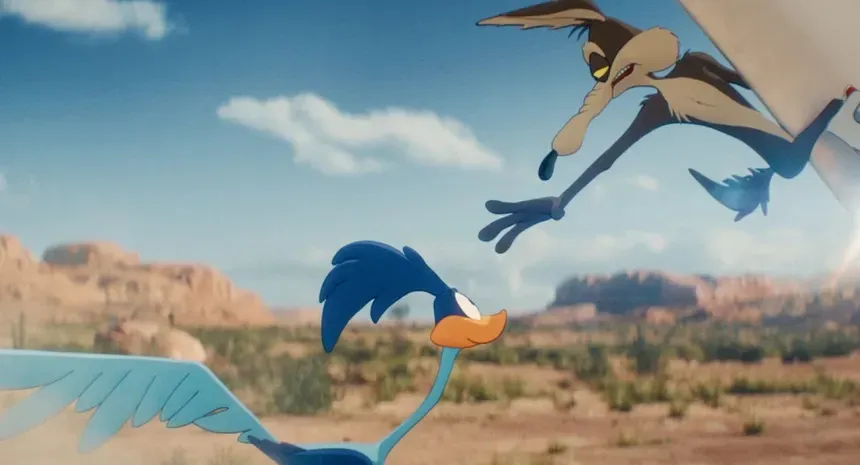
In a sense, it is not surprising that the Zaslav regime at Warner Bros wanted nothing to do with Coyote Vs ACME and preferred to shelve it as a tax dodge. What they likely saw a simple cartoon film for kids was instead delivered to them as a complex, comedic, but ultimately unafraid barb at the concept that power buying impunity is an acceptable or just outcome when power is used to victimize. The fan-led effort demanding that the film see the light of day was born from that exact same impulse, that basic human pull towards fairness and decency. It is a testament to the justness of those impulses that this underground momentum and the upswell of support it created set into motion the events which would precipitate the film’s sale to Ketchup Entertaiment and the long-awaited theatrical release. It took a long time, but the Looney Tunes won out.
Coyote Vs ACME deserved to be seen when it was shelved in 2023, and it deserves to be seen now at a moment the message beneath the gags has become more resonant if anything. It maintains the purity of the core humor of the cartoons without relying too heavily upon them, builds an earnest story and a robust world into which its cast and crew visibly threw their very best efforts, and audiences everywhere benefit immeasurably as a result.
Now, if Wile E. can just figure out a surefire way to catch the Road Runner, this could really be the start of something special.